If you’re living with controlling parents, home can feel heavy even when nothing looks “wrong” from the outside. You may second-guess simple choices, hide small decisions, or feel guilty for wanting space. That can wear you down little by little.
The good news is that you’re not helpless. In this guide, you’ll learn what overcontrol really looks like, how it affects daily life, and what you can do next. You’ll discover calming conversation scripts, actionable guidance, and practical indicators that can help you decide when seeking professional support is the best next step.
What Does “Controlling Parents” Mean?
In this article, the term controlling parents refers to parents who move beyond healthy guidance and attempt to influence or control their child’s thoughts, decisions, emotions, or personal relationships. Healthy parenting gives support and structure. Psychological control uses guilt, fear, pressure, or shame to keep power in the parent’s hands.
Why does this matter so much? Because children and teens need room to grow. The American Psychological Association highlighted research that followed 422 children over eight years and found that overcontrolling parenting was linked with poorer emotional and behavioral regulation later on. The CDC also reports that 40% of U.S. high school students had persistent feelings of sadness or hopelessness in 2023. Not all of that comes from parenting, of course. Still, emotional safety at home matters a lot.
Main Signs or Symptoms
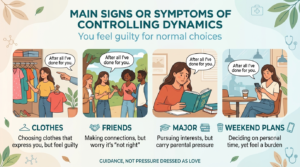
You feel guilty for normal choices
A big warning sign is constant guilt. Maybe you pick your own clothes, friends, major, or weekend plans and then get hit with “After all I’ve done for you.” That’s not guidance. It’s pressure dressed up as love.
Privacy is treated like a threat
Does your parent read messages, demand passwords, or walk into your room without knocking? That shows poor boundaries. Safety checks can be reasonable in some situations. Still, nonstop monitoring teaches you that privacy is suspicious instead of normal.
Love feels warm only when you obey
This one hurts. If affection disappears when you disagree, you may be dealing with conditional love. A parent may become cold, dramatic, or silent until you come back into line. Over time, this behavior can condition you to prioritize avoiding conflict, even when it means sacrificing your own needs or well-being.
Your decisions are made for you
Some parents call every shot. They choose your classes, clothes, hobbies, career path, or even who you should date. Advice is one thing. Decision control is something else. When your opinions are consistently ignored or dismissed, it points to a deeper issue that deserves attention.
Boundaries bring anger, tears, or threats
What happens when you say no? If a simple limit sparks rage, crying spells, insults, or threats of abandonment, the issue usually isn’t your tone. It’s the parents’ need for control. That reaction often teaches kids to stay quiet just to avoid drama.
How Controlling Parents Affect Daily Life
Overcontrol doesn’t stay in one corner of life. It can shape your mental well-being, your confidence, and even your daily routine. Checking your phone can become a source of anxiety. You might replay conversations repeatedly, wondering if you said the wrong thing. Eventually, even harmless choices may be hidden because honesty no longer feels safe.
It also spills into relationships and family life. A long-term study summarized by the Society for Research in Child Development found that overcontrolling parenting at age 13 was linked with less supportive romantic relationships and lower educational attainment by adulthood. In plain English, the habit of being controlled can follow you into school, work, love, and decision-making later on.
Practical Solutions
Name the pattern without arguing about labels
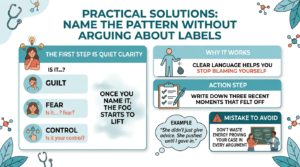
The first step is quiet clarity. Your feelings and perspective remain valid, even if your parent doesn’t agree with how you express them. You just need to notice the pattern. Take a moment to consider the real motive. Does it come from guilt, fear, or control presented as concern? Simply recognizing the situation can bring greater clarity and help you see things more clearly.
- Why it works: Clear language helps you stop blaming yourself.
- Action step: Write down three recent moments that felt off.
- Example: “She didn’t just give advice. She pushed until I gave in.”
- Mistake to avoid: Don’t waste energy proving your case in every argument.
Use short, calm boundaries
Long speeches often backfire on controlling people. They may search for opportunities to misinterpret what you say, distort the facts, or draw you into unnecessary arguments. A short boundary works better. Think of it as closing a door gently rather than wrestling it shut.
- Why it works: Calm boundaries reduce emotional fuel.
- Action step: Pick one script and repeat it.
- Example: “I’m not discussing that today.” “I’ve made my decision.”
- Mistake to avoid: Don’t over-explain unless safety requires it.
Stop asking for permission when you mean to inform
This shift is small. Still, it can change everything. If you are old enough to make a choice safely, try informing instead of asking. Why? Because asking invites a vote. Informing shows adult independence.
- Why it works: It breaks the habit of handing over your power.
- Action step: Replace “Can I go?” with “I’m going out at 4, and I’ll be back by 7.”
- Example: “I’ve booked the class already.”
- Mistake to avoid: Don’t use this if it would put you at risk.
Build support outside the control loop
You need people who reflect reality to you. That might be a sibling, a cousin, a friend, a school counselor, a therapist, a faith leader, or a support group. When one voice dominates your life, outside support helps you breathe again.
- Why it works: Healthy support reduces isolation and confusion.
- Action step: Tell one trusted person one specific thing that keeps happening.
- Example: “She goes through my private messages and says it’s because she cares about me.” It doesn’t feel loving.”
- Mistake to avoid: Don’t share with someone who reports everything back home.
Make a safety plan if control turns frightening
In some cases, controlling behavior can escalate into emotional abuse, intimidation, stalking, or using money as a way to limit someone’s freedom. . At that point, the goal is not winning an argument. The goal is safety. Ask yourself a hard question: if I set a limit, what might happen next?
- Why it works: Planning lowers panic in tense moments.
- Action step: Save important numbers, keep copies of documents, and identify a safe place to go if needed.
- Example: A packed bag at a trusted relative’s home can matter more than a perfect speech.
- Mistake to avoid: Don’t announce a big boundary plan to someone who may retaliate.
Special Situations
Control often spreads through the whole family tree. If your partner says, “Your mom still runs our home,” take that seriously and if a mother-in-law pushes into parenting decisions, use one united message with your spouse. If you have children, be careful not to pass the pattern down by ruling through guilt instead of guidance.
Older family members can be tricky too. An elder parent may need help with money, health, or transport. Even then, help does not erase your right to limits. You can be kind and still say, “I can drive you on Thursday. I can’t come every day.” That’s not cold. That’s sustainable care.
Comparison Table
| Situation | Healthy Guidance | Controlling Behavior | Better Response for You |
| School or career choice | Shares advice and asks questions | Demands one path and shames disagreement | “I hear your view. I’m making this decision myself.” |
| Phone and privacy | Sets clear age-based safety rules | Reads messages without respect or reason | “I’m open to safety talks. I’m not okay with secret monitoring.” |
| Dating or friendships | Talks about red flags and values | Bans people from keeping power | “I’ll consider your concerns. I’ll choose my relationships.” |
| Daily schedule | Expects basic communication | Requires constant updates and approval | “I’ll let you know my plan. I won’t ask permission for every step.” |
| Parenting your own child | Offers help when asked | Takes over and undermines you | “Thanks. We’re handling this as the parents.” |
When to Get Professional Help
Please don’t wait until you’re completely drained. Professional help makes sense when control is causing anxiety, panic, depression, isolation, sleep problems, or conflict that feels impossible to manage alone. It also matters if you fear punishment, stalking, threats, or financial control.
A therapist, school counselor, family counselor, or domestic abuse service can help you sort out what’s happening and plan next steps. If you or someone you love is in crisis, call or text 988 in the United States for immediate mental health support. The CDC links to the 988 Lifeline as a free and confidential resource.
My experience
I’ve dealt with controlling parents myself, and it can make even small choices feel stressful. At times, I felt guilty for wanting space and worried about upsetting my family. What helped me most was learning to set calm boundaries and trust my own decisions little by little.
Conclusion
If controlling parents have shaped your home, you are not weak, and you are not “too sensitive.” You may simply be reacting to a pattern that trained you to stay small. Once you see that pattern clearly, you can start making steady changes that protect your peace.
Start small today. Pick one boundary, one support person, and one next step. That’s enough for now. You don’t have to untangle everything in one weekend. Little by little, you can build a life that feels calmer, freer, and more like your own.