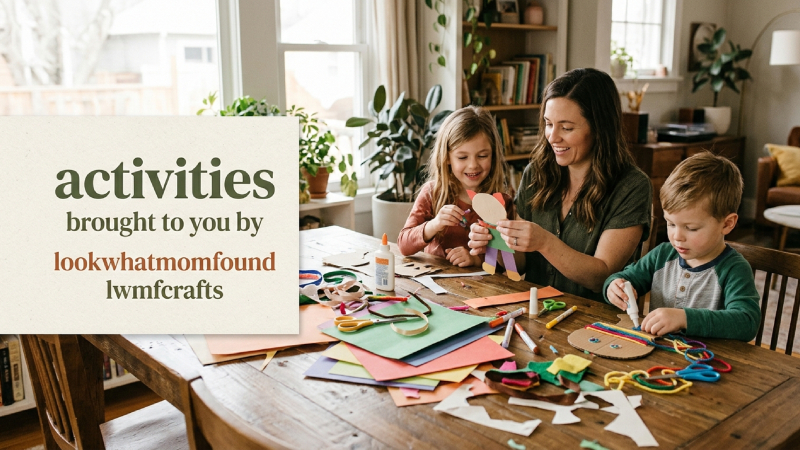
It’s four in the afternoon, the kids are restless, and the recycling bin happens to be full of exactly what a craft needs. That’s the moment most family craft ideas are made for, including the ones tied to LookWhatMomFound, a family blog that puts the LWMFCrafts label on some of its kids’ activity posts. activities brought to you by lookwhatmomfound lwmfcrafts?
This guide covers what those projects look like, how to fit them to a child’s age, what’s actually worth buying, and where the real safety risks hide. Treat the activities brought to you by lookwhatmomfound lwmfcrafts as starting points you can bend to whatever you have on hand.
A quick disclosure before we go on. The five main projects below match a list in one of the site’s craft posts, but that post gives each idea only a line or two. The steps, age ranges and safety advice here are general guidance, not the site’s own instructions.
What LWMFCrafts Actually Covers
LookWhatMomFound calls itself a family blog with daily life hacks. Its main menu covers family life, travel, reviews and giveaways, with no craft item, though a “Crafts for Kids” tag exists. LWMFCrafts shows up inside post titles, which promise anywhere from three to twenty activities. A 2024 post lists five ideas: paper plate animals, string painting, homemade playdough, a cardboard box playhouse and a nature walk collage.
Some pages claim the abbreviation means “Lightweight Multi-Faceted Crafts.” Nothing suggests the site uses that expansion. The letters echo the LookWhatMomFound name, and the made-up definitions turn up mostly on low-quality aggregator sites.
What the projects have in common
They use household materials, take little setup, and have no single right answer, so a lopsided lion is still a lion.
Activity Categories at a Glance
The table sorts the five projects by materials, mess and rough starting age, and shows what the site’s 2024 post says about each. Treat the ages as loose. A patient four-year-old can outlast an impatient seven-year-old without much trouble.
|
Category |
Typical materials | Mess level | Rough starting age | What the 2024 post says |
| Paper plate crafts | Paper plates, construction paper, child-safe glue | Low | 3+ |
Plates, glue and markers make animals |
|
String painting |
Yarn or string, washable paint, paper | High | 3+ (younger with help) | Yarn dipped in paint and dragged across paper |
| Homemade playdough | Flour, salt, water, oil, food coloring | Medium | 2+ with close supervision |
Homemade dough for sensory play |
|
Cardboard builds |
Boxes, tape, markers, adult-cut openings | Medium | 4+ (adult handles cutting) | Old boxes become playhouses, rockets or castles |
| Nature collages | Leaves, petals, flat seeds, clear contact paper | Low | 3+ |
A collage from a walk’s finds |
Paper Plate Animals and Other Paper Crafts
A paper plate does a lot of work for something that costs pennies. It holds up under glue, lies flat on the table, and arrives already round, which covers most of a lion’s face or a ladybug’s body.
Hand your child one plate, some colored scraps and a glue stick, then let them pick the animal. If it ends up looking like nothing from any zoo, good. Older kids might add a fringed paper mane or folded strips for legs.
Puppets are a natural next step, though they aren’t on the site’s list. A paper bag or a spare sock gives you the base, and scraps and a marker supply the face. Skip buttons for eyes if a younger child is nearby.
Tearing paper deserves a mention too. It looks like nothing, but all that pinching and ripping builds the small hand muscles kids lean on later for writing and doing up buttons.
String Painting and Process Art
String painting turns the paintbrush upside down. Dip a length of yarn in washable paint, then drag or press it across a sheet of paper. The lines come out loopy and surprising, and no child could draw them on purpose.
It’s a good example of process art, where doing the thing matters more than what’s left afterward. Many early-childhood educators like the approach because there’s nothing to get wrong. Resist the urge to fix the result or ask what it’s supposed to be. Something like “you used a lot of blue” keeps the attention on the doing.
Put newspaper or a washable cloth down, find an old shirt, and keep wipes within reach. It will get messy. That’s the deal.
Homemade Playdough
Cooked playdough, made from flour, salt, water and a splash of oil, has lasted for good reason. It costs almost nothing, feels great, and a child can do the stirring. A batch takes roughly fifteen minutes on the stove, and the stove part belongs to an adult. The cooking matters for more than texture. Raw flour can carry germs such as E. coli, and the CDC advises against letting children play with raw dough, craft dough included.
When it cools, kids can roll it, squash it, cut it and poke things into it. Cookie cutters, a plastic knife or a few craft sticks often buy a quiet half hour.
Store it in an airtight container, and throw it out if it turns sticky or starts to smell.
Homemade dough is very salty and isn’t food. Some recipes hold enough salt to harm a small child who swallows only a modest amount. Keep it out of mouths, watch young children closely, and call Poison Help at 1-800-222-1222 if a child eats any meaningful amount.
Cardboard Playhouses and Recycled Builds
A big box is free entertainment. An appliance carton can turn into a house, a rocket or a shop, and children often play with it longer than they played with whatever came inside.
An adult should cut the doors and windows with a box cutter and then tape or sand any rough edges. After that, the child takes over with markers, paint, fabric scraps or stickers.
Small builds count too. A cereal box becomes a robot, and a toilet paper tube becomes a pair of binoculars. Projects like these also show children that “trash” can have a second life, which plenty of families like to point out.
Nature Collages
Start with a walk. Give your child a bag and ask for fallen leaves, petals, grass, flat seeds and small twigs. At home, press the finds onto a sheet of clear contact paper with the sticky side up, then cover it with a second sheet. Tape it to a window and the light comes through.
Leave out anything toxic, spiky or likely to set off an allergy, and if you aren’t sure about a plant, skip it. Children who still put things in their mouths shouldn’t handle small natural items. Wash hands afterward.
Matching Activities to Age
A craft that frustrates a child ends early, so level matters more than cleverness. Think of the activities brought to you by lookwhatmomfound lwmfcrafts as a menu you can scale up or down.
|
Age range |
What they can usually do | Good fits | What to adjust |
| 2 to 3 | Squeeze, tear, stamp, scribble | Playdough, finger painting, simple collage |
Use large pieces and stay within arm’s reach |
|
4 to 5 |
Glue, color, begin using safety scissors | Paper plate animals, string painting, nature collages | Offer two choices, not ten |
| 6 to 8 | Follow several steps, plan a design | Cardboard builds, layered paper crafts |
Let them lead, with an adult for cutting and heat |
|
9 and up |
Work independently, combine materials | Larger recycled builds, remixing old projects | Ask what they’d change next time |
Adapting Projects for Seasons
The same handful of projects stretch across the year with small swaps. You don’t need a fresh idea every week, only a new twist on one that already worked.
In autumn, a nature collage can use red and gold leaves, and paper plate animals can turn into owls or hedgehogs. Winter suits string painting on dark paper with white paint, which looks a bit like snowfall. In spring, press flower petals into homemade dough. Summer is the time to haul cardboard builds outside, where a boat or castle can survive a splash.
Setting Up a Session That Doesn’t Fall Apart
Most craft meltdowns start with setup, not with the child. A few habits head them off.
Get everything out before you call anyone over. Kids lose interest fast while you hunt for the tape, so lay out supplies, protect the table and keep a damp cloth handy.
Limit the choices. Five materials feel exciting, but thirty feel like homework.
Keep it short. Twenty to thirty minutes is plenty for younger children. If they’re still absorbed, great. If not, stopping early beats pushing on.
Show a step once, then step back. Fixing their work quietly teaches them that the adult version is the goal.
And make cleanup pzart of the activity. Wiping the table and snapping on lids lands better when it isn’t a punishment tacked on at the end.
Safety Checks Worth Doing First
Craft articles tend to rush this part, and they shouldn’t. With the activities brought to you by lookwhatmomfound lwmfcrafts, the main risks come from small parts, swallowing and sharp tools.
The Consumer Product Safety Commission’s small-parts rule exists to protect children under three. A widely used home test is a toilet paper tube: anything that fits through it is too small for a child under three, or for any child who still mouths objects. That covers beads, googly eyes, buttons and dried beans. For supplies, look for products labeled non-toxic, and a seal from the Art and Creative Materials Institute is one recognizable marker. Labels don’t replace supervision, though.
|
Hazard |
Where it appears | What to do |
| Choking | Beads, buttons, googly eyes, seeds |
Skip for kids under three, or use large pieces only |
|
Ingestion |
Playdough, glue, paint | Choose non-toxic products, keep out of mouths, watch closely |
| Cuts | Box cutters, scissors, torn cardboard |
Adult cuts, child uses safety scissors, tape rough edges |
|
Heat |
Stove-cooked dough, glue guns | Adult only, kids stay at a safe distance |
| Allergies | Flour, food coloring, plants, latex |
Check ingredients and skip anything that’s a known trigger |
If your child has allergies, eczema or sensitive skin, read ingredient lists and test materials on a small patch first. When in doubt, ask your pediatrician.
Building a Simple Craft Kit at Home
A small kit you can grab in ten seconds makes spontaneous crafting far likelier. Use one bin or a shoebox, and let your child help fill it and put it away.
The basics are child-safe glue sticks, washable markers, safety scissors, masking tape, a stack of paper and some yarn. Add a jar for odds and ends, such as cardboard tubes, fabric scraps and clean egg cartons. If toddlers live in the house, keep anything small on a high shelf.
You don’t need to empty a craft-store aisle. Let the kit grow slowly, and drop anything that sits untouched for months.
What Children Actually Gain From Crafting
No single project will make a child smarter, and crafting isn’t a miracle. The benefits people usually describe are modest, but they’re real enough to be worth knowing.
Cutting, tearing, pinching and gluing build fine motor control. Open-ended projects give kids practice at making choices and finishing what they start. Working side by side creates a natural reason to talk, which helps vocabulary. And there’s the quiet pride of holding something you made yourself.
Parents get something out of it too. The activities brought to you by lookwhatmomfound lwmfcrafts swap some screen time for something tactile, using materials you already own. It won’t cure every restless afternoon, but it helps.
Frequently Asked Questions
Is LWMFCrafts an official company or a blog section?
On the site it appears as a label in post titles, not as a separate company or store, and the main menu has no craft section. Be careful with unofficial sites that use the name, and check project details at the original source.
Do I need to buy special supplies?
Usually no. Paper, cardboard, yarn, flour, salt and a few finds from a nature walk cover most of the projects here. A glue stick, washable paint and safety scissors are the only purchases worth making.
What’s the best first craft for a toddler?
Homemade playdough or simple finger painting, with an adult close by. Both let toddlers squeeze, press and explore without needing precise skills.
How do I keep crafts from becoming a mess?
You can’t remove the mess, but you can contain it. Use a washable tablecloth, put paint in shallow containers and keep wipes nearby. The activities brought to you by lookwhatmomfound lwmfcrafts that involve paint or dough belong at the kitchen table, not on the couch.
Can older kids still enjoy these projects?
Yes, with a twist. Older children can design bigger cardboard builds, mix materials, or teach a younger sibling how to make something. Giving them ownership of the project keeps it from feeling babyish.
Conclusion
Family crafting doesn’t need a big budget or a picture-perfect finish. Paper plates, string, dough, cardboard and a walk outside are enough to fill an afternoon and give a child something to be proud of.
Pick projects that fit your child’s age, prepare a little before you start, and keep the safety checks simple but real. Let the results come out messy and lopsided. That’s usually where the best part of the afternoon is hiding.
Click for more details