Family Rules for Kids: Simple House Rules That Actually Work
Family rules for kids are simple, positive guidelines that help children learn respect, safety, responsibility, and self-discipline at home. The best family rules are simple, consistent, age-appropriate, and easy for children to remember and follow every day.
When kids understand what’s expected of them, they usually feel safer and more confident. They also make better choices. Strong family house rules are not about control. They are about building a calm, respectful home.
Quick Summary: Good Family Rules at a Glance
|
Rule Area |
Example Rule |
Why It Matters |
|
Respect |
Speak kindly to each other |
Builds trust and emotional safety |
|
Safety |
Ask before leaving the house or yard |
Keeps children protected |
|
Responsibility |
Clean up your own mess |
Teaches ownership |
|
Honesty |
Tell the truth, even when it’s hard |
Builds integrity |
|
Routine |
Follow morning and bedtime routines |
Reduces stress and conflict |
|
Screen Time |
Use devices only at approved times |
Supports balance and limits |
|
Family Life |
Help with age-appropriate chores |
Encourages teamwork |
|
Behavior |
Keep hands, feet, and words respectful |
Prevents hurtful behavior |
Why Family Rules for Kids Matter
Kids need boundaries. Not harsh ones. Clear ones.
The right family rules for kids help children understand what is okay, what is not, and what happens next. That predictability lowers stress. It also helps children develop self-control.
Rules also reinforce family values for kids. If your family values kindness, honesty, and responsibility, your rules should reflect those values in daily life.
Good rules do three important jobs:
- Protect safety
- Teach respect
- Build responsibility
That is why the best rules for children at home are simple enough to remember and consistent enough to trust.
15 Effective Family Rules for Kids to Begin With
If you want a strong starting point, begin with these good family rules:
- Speak with respect.
- Keep hands, feet, and objects to yourself.
- Tell the truth.
- Listen when someone is talking.
- Clean up after yourself.
- Follow morning and bedtime routines.
- Ask before using someone else’s things.
- Use kind words, even when upset.
- Do homework and chores before screen time.
- Knock before entering a room.
- Help when the family needs it.
- Take care of pets, toys, and shared spaces.
- Use devices only with permission or at set times.
- Apologize and make it right after mistakes.
- Stay where a parent or caregiver can find you.
These are strong house rules for kids because they are practical. They work in real homes. They also apply to many ages with small adjustments.
Family Rules Examples by Category
Respect Rules
Respect should be the backbone of every home.
Useful family rules examples include:
- We speak kindly to each other.
- We do not interrupt.
- We respect privacy.
- We ask before borrowing.
These rules help children understand that respect should be shown to everyone, not only adults.
It goes both ways.
Safety Rules
Safety rules protect children from risks they may not fully understand yet.
Examples include:
- Ask before going outside.
- Wear a helmet when riding bikes or scooters.
- No playing near the stove, street, or pool without an adult.
- Tell an adult where you are going.
These are key house rules every child should follow, since safety should always come first.
Responsibility Rules
Responsibility grows with repetition.
Examples include:
- Put dirty clothes in the hamper.
- Put toys away before starting a new activity.
- Bring school items back to the right place.
- Finish assigned chores.
These household rules help children build the skills they’ll need to become more independent over time.
Routine and Behavior Rules
Behavior improves when routines are clear.
Examples include:
- Brush teeth before bed.
- Homework before TV.
- No yelling inside the house.
- Use calm bodies during indoor play.
These are practical kids’ behavior rules and effective home rules for children because they reduce daily power struggles.
Age-Appropriate Family Rules for Different Stages
Not every rule fits every age. The most effective family rules are those that fit a child’s age and stage of development.
Toddlers and Preschoolers
Young children need short, concrete rules.
Try:
- Use gentle hands.
- Stay where I can see you.
- Pick up toys when finished.
- Use inside voices.
At this age, fewer rules work better. Aim for three to five core rules.
School-Age Kids
School-age children can handle more detail.
Try:
- Finish homework before screens.
- Pack your bag before bedtime.
- Help clear the table.
- Speak respectfully, even when frustrated.
This is a good stage to start discussing consequences and accountability.
Tweens and Teens
Older kids need more responsibility and more voice.
Try:
- Keep your phone use within agreed limits.
- Be honest about where you are.
- Respect curfew.
- Contribute to the household weekly.
For older children, family expectations for kids should feel fair, clear, and connected to trust.
How to Create Positive Family House Rules
The best positive family rules do not just tell kids what to stop doing. They tell kids what to do instead.
For example:
- Instead of Don’t yell, say Use a calm voice.
- Instead of Don’t be rude, say Speak respectfully.
- Instead of Don’t make a mess, say Clean up after yourself.
Here is what makes family house rules more effective:
Keep the List Short
Too many rules get ignored.
Start with five to ten. Focus on the behaviors that matter most.
Use Clear Language
Avoid vague wording.
“Be good” is unclear. “Speak kindly” is clear.
Involve Your Kids
Children tend to follow rules more willingly when they’re involved in setting them.
Ask:
- What helps our home feel peaceful?
- What rules help everyone feel respected?
- What should happen when someone forgets?
Tie Rules to Values
Rules stick when kids know the reason behind them.
If your value is respect, explain how the rule supports respect. If your value is safety, explain the risk.
That is how family discipline rules become teaching tools, not just punishments.
Family Rules Checklist for Parents
Use this family rules checklist before posting or enforcing new rules.
A strict rule should be:
- Easy to understand
- Short enough to remember
- Stated positively when possible
- Appropriate for your child’s age
- Consistent with your family’s values
- Realistic to enforce
- Applied fairly
- Supported by clear consequences
- Modeled by adults
- Relevant to daily home life
If a rule fails most of this checklist, rewrite it.
Family Routine for Kids: How Rules Work Better With Daily Habits
Rules work best when paired with a predictable family routine for kids.
Children do not thrive on correction alone. They thrive on repetition.
Here is how routines support rules:
Morning Routine
- Get dressed
- Brush teeth
- Eat breakfast
- Pack school items
After-School Routine
- Put shoes and bag away
- Have snack
- Finish homework
- Do chores
- Enjoy free time
Bedtime Routine
- Bath or wash up
- Pajamas
- Teeth brushed
- Quiet reading
- Lights out
When routines are predictable, parents repeat themselves less. Kids argue less too.
Teaching Kids Family Rules Without Constant Nagging
Teaching kids family rules takes more than saying them once.
Children learn best through repetition, modeling, and calm correction.
Model the Behavior
If adults interrupt, yell, or ignore routines, children notice.
The fastest way to weaken a rule is to break it yourself.
Practice the Rule
Do not just explain it. Rehearse it.
If the rule is “Knock before entering,” practice knocking. If the rule is “Use kind words,” role-play what that sounds like.
Praise What You Want Repeated
Catch the behavior early.
Say:
- I noticed you cleaned up without being asked.
- Thank you for using a calm voice.
- You told the truth. That was brave.
Praise builds momentum.
Use Consequences That Make Sense
Consequences should connect to the behavior.
For example:
- Toys left out may be put away for a while.
- Rough behavior ends the game.
- Missed homework may mean no screens yet.
This is more effective than random punishment.
Stay Consistent
A rule that changes every day is not really a rule.
Consistency is what turns expectations into habits.
Printable Family Rules Ideas
A printable family rules sheet helps children see expectations every day.
You can keep it simple. In fact, simple is better.
Your printable can include:
- A short title
- Five to ten rules
- Small icons for younger children
- A family values line
- A signature section
A visual family rules chart or family rules poster works especially well in kitchens, playrooms, classrooms, and homeschool spaces.
Use large, easy-to-read wording like:
- Be kind
- Be honest
- Be safe
- Help out
- Clean up
- Listen well
Sample Family Rules Chart
Here is a ready-to-use family rules chart you can copy, print, or turn into a poster.
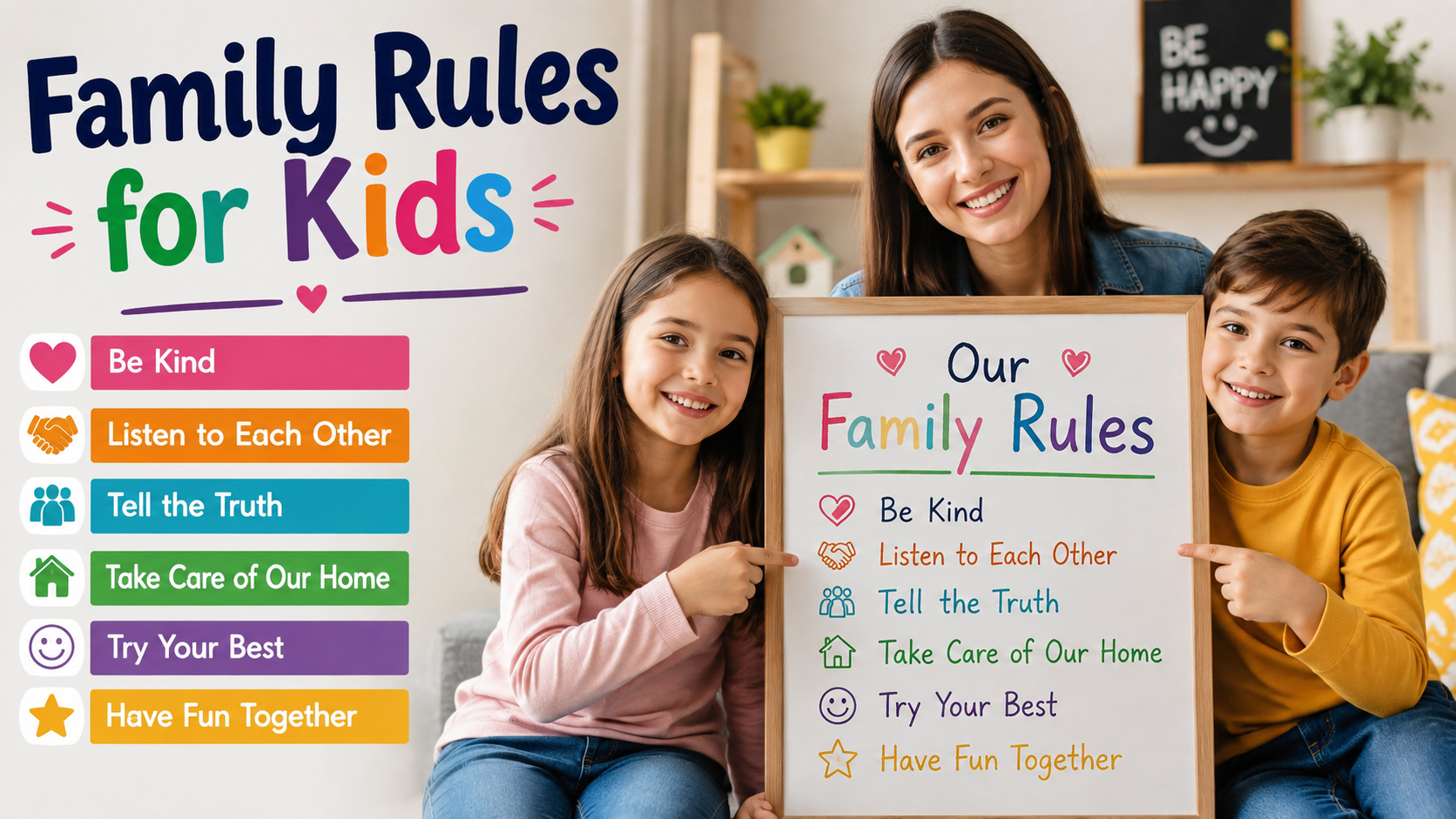
Our Family Rules
- We speak kindly.
- We listen the first time.
- We keep hands and feet to ourselves.
- We tell the truth.
- We clean up our messes.
- We help with chores.
- We follow our routines.
- We take care of our things.
- We respect privacy and personal space.
- We make things right after mistakes.
This list works well as a family rules poster because it is short, positive, and easy to remember.
Key Takeaways
- Family rules for kids should be clear, positive, and consistent.
- The best rules teach respect, safety, responsibility, and self-control.
- Strong family rules examples are easy to say and easy to enforce.
- The most effective house rules for kids are age-appropriate.
- Routines make rules easier for children to follow.
- A printable family rules list or chart helps reinforce expectations daily.
FAQ
What are the best family rules for kids?
The best family rules for kids focus on respect, honesty, safety, responsibility, and routines. Good examples include speaking kindly, telling the truth, cleaning up after yourself, and following bedtime rules.
What are basic house rules for children?
Basic house rules for children usually include using kind words, listening to adults, keeping hands to themselves, cleaning up messes, and asking permission before going outside or using certain items.
How many family rules should kids have?
Most families do best with five to ten core rules. Fewer rules are easier to remember, teach, and enforce.
What are positive family rules?
Positive family rules tell children what to do instead of only what not to do. For example, “Use a calm voice” works better than “Don’t yell.”
How do I make a printable family rules list?
Choose five to ten short rules, use child-friendly wording, and print them in large text. Add icons for younger children. A simple family rules checklist or family rules poster can be placed in a common area.
How do I teach family rules without punishing all day?
Teach rules through modeling, practice, praise, routines, and logical consequences. Children respond better to calm consistency than constant correction.
What are good family expectations for kids?
Strong family expectations for kids include being respectful, helping at home, telling the truth, following routines, and taking responsibility for their choices.
Click here for more details.