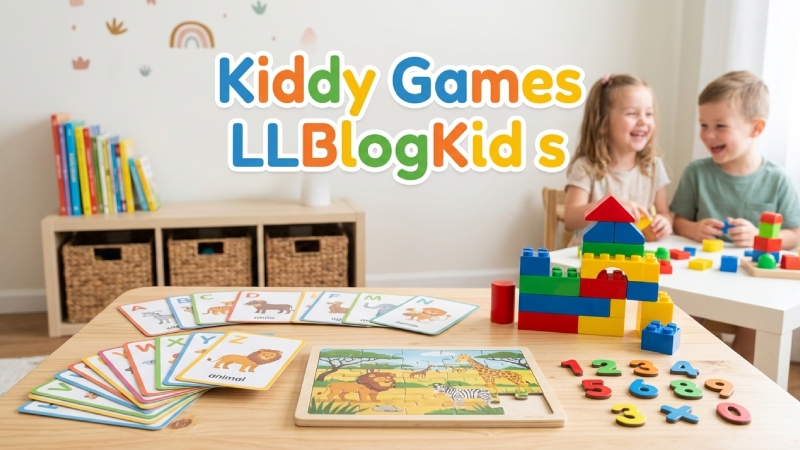
The best Kiddy Games LLBlogKids ideas are simple, age-appropriate activities that help children learn while playing. Try matching games, movement challenges, storytelling, puzzles, building tasks, and family games that develop thinking, language, creativity, and coordination.
Quick Summary
|
Age group |
Game example |
Main skills |
Materials |
Typical time |
|
2–4 |
Color Hunt | Vocabulary and observation | Household objects |
5–10 minutes |
|
3–5 |
Story Sequence | Memory and language | Picture cards |
10 minutes |
|
4–7 |
Number Shop | Counting and communication | Toys and paper coins |
10–15 minutes |
|
5–8 |
Shape Builder | Spatial thinking | Blocks or craft sticks |
15 minutes |
|
6–10 |
Treasure Map | Reasoning and teamwork | Paper and pencil |
20 minutes |
|
8–12 |
Family Trivia | Recall and communication | Question cards |
15–20 minutes |
Kiddy Games LLBlogKids: What Parents Should Look For
Good games do not need expensive equipment. They need a clear purpose, flexible rules, and enough challenge to keep children interested.
When choosing Kiddy Games LLBlogKids activities, look for these qualities:
- Age appropriate: The rules match the child’s development.
- Easy to explain: Children understand the first step quickly.
- Active or interactive: The activity encourages movement, talk, or decision-making.
- Adaptable: Parents can make the game easier or harder.
- Low cost: Household items are enough.
- Social: Children can play with siblings, classmates, or adults.
- Safe: The activity suits the child’s physical abilities and environment.
The strongest kiddy games for kids balance enjoyment with a small learning goal. That goal might be counting, sorting, listening, remembering, moving, or explaining an idea.
Why Learning Through Play Matters
Learning through play helps children practice skills in a natural setting. They can test ideas, make mistakes, try again, and receive feedback without feeling like they are taking a formal test.
UNICEF explains that play can support problem-solving, communication, social interaction, emotional expression, and the parent-child bond. Building with blocks can develop spatial understanding, while hiding and finding objects can encourage concentration and flexible thinking.
Play also gives adults useful insight. You may notice how a child handles frustration, follows directions, shares materials, or explains a decision.
What children can practice through games
- Language: Naming objects, telling stories, and asking questions.
- Thinking: Comparing, predicting, sorting, and solving problems.
- Memory: Recalling rules, sequences, and details.
- Movement: Balancing, throwing, jumping, and dancing.
- Creativity: Drawing, building, pretending, and inventing.
- Social skills: Taking turns, negotiating, listening, and cooperating.
- Emotional skills: Waiting, managing disappointment, and expressing feelings.
Games for Preschoolers
Children ages three to five often enjoy pretend play, songs, movement, matching, and short challenges. Keep the rules brief. Offer help without taking over.
The CDC notes that play, learning, language, movement, and behavior provide useful clues about a child’s development. By age four, many children engage in pretend play, use longer sentences, identify some colors, continue familiar stories, and participate in simple games.
1. Color Hunt
Goal: Build color vocabulary and observation.
How to play:
- Choose one color.
- Ask the child to find three objects with that color.
- Let the child describe each object.
- Choose another color.
For younger children, use two colors. For older preschoolers, ask them to sort objects by color, size, or purpose.
2. Story Sequence
Goal: Support memory, language, and logical order.
Draw three simple pictures. For example, show a seed, a plant, and a flower.
Mix the pictures. Ask the child to place them in order. Then ask what happened first, next, and last.
3. Freeze Dance
Goal: Improve listening and self-control.
Play music while children dance. Stop the music suddenly. Everyone freezes until the music starts again.
Add variations:
- Freeze like an animal.
- Freeze with one foot raised.
- Freeze in a superhero pose.
- Freeze when you hear a specific word.
The CDC recommends simple movement games, including freeze dance, red light-green light, tag, and follow-the-leader for young children.
4. Matching Pairs
Goal: Practice visual memory and concentration.
Place pairs of similar objects face down. Players turn over two objects at a time.
If they match, the player keeps the pair. If the cards are not a match, place them face down again.
Use socks, cards, toy animals, or homemade picture cards.
Fun Games for Children Ages 5–7
Children in this age group can usually follow several steps. They also enjoy challenges with a visible goal.
These fun games for children work well at home, in classrooms, or during family time.
1. Word Detective
Choose a letter. Children search the room for objects beginning with that sound.
For example, with the letter “B,” they might find a book, ball, or basket.
For early readers, write the words on cards. Ask children to match each word with the correct object.
2. Number Shop
Set up a pretend shop with toys. Give children paper coins.
Each item receives a simple price. The child must count coins to “buy” an item.
You can add questions:
- Which item costs more?
- Which item costs less?
- How many coins remain?
- Can you buy two items?
This activity turns counting into a practical story.
3. Shape Builder
Give children craft sticks, blocks, or strips of paper.
Call out a shape. Children build it. Then ask them to create something using that shape.
For example, a triangle might become a roof. A rectangle might become a door.
4. Sound-and-Action Game
Choose an action for each sound.
- Clap when you hear “M.”
- Jump when you hear “S.”
- Turn around when you hear “T.”
Read a short story aloud. Children listen and respond to the sounds.
This game combines phonics, attention, movement, and memory.
Educational Games for Kids That Build Real Skills
The best educational games for kids connect a skill with an enjoyable task. Children should understand what to do without needing a long explanation.
Literacy games
Try these activities:
- Rhyming basket: Find words that rhyme with “cat.”
- Story builder: Pick a character, place, and problem.
- Letter hunt: Find objects that begin with a chosen letter.
- Sentence relay: Add one sentence to a shared story.
- Picture prediction: Guess what happens next.
Math games
Use ordinary objects for simple practice:
- Count buttons, blocks, or toy cars.
- Sort objects by size.
- Compare groups.
- Create repeating patterns.
- Estimate how many items fit in a container.
- Play a pretend restaurant using menus and prices.
Memory and logic games
These brain games for children do not need complicated apps. Try:
- Matching pairs.
- “What changed?” with five household objects.
- Simple riddles.
- Pattern copying.
- Odd-one-out sorting.
- “I’m thinking of something” clues.
Physical development games
Movement games can support balance, coordination, and body awareness.
Try:
- Follow the leader.
- Animal walks.
- Beanbag toss.
- Balance-path challenges.
- Balloon keep-up.
- Red light-green light.
Always adjust the space and rules for the child’s age. Remove sharp objects and obstacles before active play.
Indoor Games for Kids With Simple Materials
Rainy days do not need to become boring days. These indoor games for kids use items you may already have. Clisk MotoAssure Complaints for more informations.
Sock Toss
Roll clean socks into soft balls. Place a basket several steps away.
Children throw the sock balls into the basket. Move the basket closer or farther away.
Skills: Hand-eye coordination, counting, and distance awareness.
Mystery Bag
Place familiar objects in a cloth bag. Children feel one object without looking.
They describe its shape, texture, and possible use. Then they guess the object.
Skills: Vocabulary, sensory awareness, and reasoning.
Paper-Plate Path
Place paper plates on the floor. Children move from one plate to another.
Give directions such as:
- Step on blue.
- Skip two plates.
- Touch the next plate with one hand.
- Move backward with help.
Skills: Listening, balance, color recognition, and movement.
Build-and-Balance Challenge
Ask children to build the tallest stable tower using blocks, cups, or cardboard.
Set a short time limit. After the tower falls, ask what they would change.
Skills: Engineering thinking, patience, planning, and problem-solving.
Creative Games for Children
Creative games for children leave room for different answers. They reward imagination rather than speed.
1. Three-Object Story
Choose three random objects. For example:
- A spoon.
- A toy dinosaur.
- A scarf.
The child creates a story using all three objects.
Ask questions to extend the story:
- Where does the story happen?
- What problem appears?
- Who helps the character?
- How does the story end?
2. Shape Drawing
Draw a circle, triangle, or wavy line. Ask children to turn it into a picture.
One child may create a sun. Another may create a robot or a monster.
There is no single correct answer.
3. Pretend Restaurant
Children create a menu, take orders, and serve pretend food.
They can count items, write prices, practice polite conversation, and solve small problems.
4. Soundtrack Game
Give children a scene. For example, “a rainy forest” or “a busy space station.”
They create sounds using safe household objects or their voices.
This activity supports listening, rhythm, imagination, and group coordination.
Family-Friendly Kids Games for Shared Play
Family-friendly kids games should allow different ages to participate. The rules can change for younger children.
Family Charades
Write simple actions or animals on paper. One player acts without speaking.
Younger children can choose from picture cards. Older children can create their own clues.
Cooperative Treasure Hunt
Hide several objects around a safe room. Give the family clues.
Everyone works together. The goal is to find all objects before time runs out.
Family Trivia
Ask questions about books, animals, food, places, or family memories.
Keep questions age appropriate. Let younger players answer with choices.
Build a Group Story
One person starts with a sentence. Each player adds another sentence.
Use a playful rule. For example, every sentence must include a color or animal.
Cooperative play helps children practice listening and turn-taking. The CDC also encourages children to play with others and learn sharing, friendship, and problem-solving skills.
Interactive Learning Activities for Home or Classroom
Interactive learning activities work best when children make choices. Instead of explaining everything, let them predict, test, and discuss.
Activity 1: Sort and Explain
Give children a collection of objects. Ask them to create groups.
They might sort by:
- Color.
- Size.
- Shape.
- Material.
- Use.
- Texture.
Then ask, “Why did you put these together?”
The explanation matters as much as the sorting.
Activity 2: Prediction Station
Fill a bowl with water. Gather safe objects.
Before testing each object, ask children to predict whether it will sink or float.
Record the results with simple drawings or marks.
Activity 3: Movement Story
Tell a story that includes actions.
For example:
- Crawl like a caterpillar.
- Stretch like a growing plant.
- Jump over a puddle.
- Spin like a falling leaf.
Children practice comprehension while moving.
Activity 4: Classroom Detective
Choose an item in the room. Give clues about it.
The clues might describe its color, shape, location, or purpose.
Children listen carefully and identify the object.
Fun Learning Activities for Kids That Need Almost No Setup
Parents and teachers often need fun learning activities for kids that start immediately.
Try these ideas:
- Count steps from one room to another.
- Find five objects shaped like circles.
- Make a rhyme for a name.
- Create a pattern with spoons and forks.
- Tell a story using three pictures.
- Guess an object from clues.
- Find something heavier and lighter.
- Copy a rhythm by clapping.
- Invent a new animal.
- Explain how to make a sandwich.
These activities are short. They can fill waiting time, travel breaks, or transitions between routines.
Easy Games for Kids During Busy Days
Easy games for kids should have minimal preparation. They should also end before children lose interest.
“I Spy”
Choose an object that children can see. Give a color or shape clue.
For older children, provide a function clue. For example, “I spy something used for writing.”
Copy My Pattern
Clap, tap, or stomp a short pattern. Children copy it.
Increase the difficulty gradually.
What’s Missing?
Place several objects on a table. Ask children to look carefully.
Hide one object. Children guess what disappeared.
Five-Second Categories
Name a category, such as animals or foods. Children say three examples quickly.
Give younger children more time. Older children can create their own categories.
Follow Two Directions
Give two simple instructions:
- Touch the chair.
- Then clap twice.
Increase the number of steps as children become comfortable.
Kids Activity Ideas for Different Learning Goals
The best kids activity ideas begin with a skill. Then you choose a playful way to practice it.
|
Learning goal |
Activity |
|
Vocabulary |
Mystery Bag |
| Counting |
Number Shop |
|
Listening |
Sound-and-Action Game |
|
Memory |
Matching Pairs |
|
Creativity |
Three-Object Story |
|
Balance |
Paper-Plate Path |
|
Teamwork |
Cooperative Treasure Hunt |
|
Emotional awareness |
Feelings Charades |
|
Early reading |
Word Detective |
|
Spatial thinking |
Shape Builder |
Do not turn every game into a lesson. Children need free play too.
A short question is often enough. Try, “What do you notice?” or “What could we try next?”
How to Make Games More Engaging Activities for Children
Engaging activities for children offer a clear start, a manageable challenge, and a satisfying finish.
Use these techniques:
Start small
Introduce one rule first. Add another rule only when needed.
Let children choose
Offer two activities. Choice increases ownership.
Use familiar objects
Toys, socks, paper, cups, and books can become game materials.
Follow their interests
A child who loves animals may enjoy animal sorting, pretend rescue games, or habitat building.
Praise effort
Say, “You tried another way,” rather than only saying, “You got it right.”
Allow mistakes
Mistakes create opportunities to test new ideas.
Change the challenge
Make a game easier by reducing choices. Make it harder by adding time, memory, or explanation.
Keep it flexible
If children invent a better rule, consider using it. Imagination is part of the activity.
Screen-Free and Screen-Supported Play
Games can be completely screen-free. They can also use digital media carefully.
The American Academy of Pediatrics recommends considering the quality and context of media use, rather than relying only on a fixed number of hours. Its guidance encourages families to protect sleep, physical activity, family connection, and other healthy routines.
For young children, ask:
- Is the content suitable for the child’s age?
- Does an adult watch or play sometimes?
- Does the activity encourage thinking or conversation?
- Is it replacing sleep, movement, reading, or social play?
- Can the child stop easily?
A digital game can be more useful when adults talk with children about what they see and do. Still, many of the best learning games need only people, space, and everyday materials.
How to Choose the Right Game for Your Child
Use this five-point check:
1. Developmental fit
The game should be challenging but not overwhelming.
2. Safety
Avoid small parts for children who may put objects in their mouths. Supervise active games.
3. Purpose
Know what the activity encourages. It might build memory, communication, balance, or creativity.
4. Social value
Choose games that practice sharing, cooperation, patience, or conversation.
5. Replay value
A strong game can change as the child grows. Add rules, new materials, or different themes.
The CDC emphasizes that developmental checklists describe what most children can do by a certain age. They are not a diagnosis. If a child loses skills or a parent has concerns, discussing them with a healthcare professional is important.
A Simple Weekly Game Plan
Families do not need a complex schedule. Try one activity from each category.
|
Day |
Game type |
Example |
| Monday | Language |
Three-Object Story |
|
Tuesday |
Movement |
Freeze Dance |
|
Wednesday |
Math |
Number Shop |
|
Thursday |
Creativity |
Shape Drawing |
|
Friday |
Memory |
Matching Pairs |
|
Saturday |
Family play |
Cooperative Treasure Hunt |
|
Sunday |
Free choice |
Child-created game |
Keep sessions short. Five focused minutes can be valuable.
The goal is connection, curiosity, and practice. It is not perfection.
Frequently Asked Questions
What are the best Kiddy Games LLBlogKids activities for preschoolers?
Start with short activities. Color hunts, matching pairs, freeze dance, pretend shops, and story sequencing work well.
Choose games with simple rules. Allow children to move, talk, and repeat the activity.
Are these educational games for kids suitable for classrooms?
Yes. Many activities work with small groups or full classrooms.
Teachers can adapt the materials and difficulty. Cooperative treasure hunts, pattern games, storytelling, and sorting activities are especially flexible.
What are the best indoor games for kids on rainy days?
Try sock toss, mystery bags, paper-plate paths, building challenges, matching games, and indoor scavenger hunts.
Clear furniture and supervise movement-based activities.
How do kids learn through games?
Games let children practice skills through action. They can count, compare, remember, communicate, create, and solve problems.
UNICEF describes play as a way to build problem-solving, communication, emotional, and social skills.
What are good brain games for children?
Matching pairs, pattern copying, “What’s Missing?”, riddles, sorting, and memory sequences are useful choices.
Keep the challenge appropriate. A game should encourage thinking without causing unnecessary frustration.
What are some easy games for kids without toys?
Try “I Spy,” story building, clapping patterns, animal walks, category games, pretend shops, and movement stories.
Paper and household objects can also create many activities.
How long should children play learning games?
There is no single ideal length for every child or activity. Preschool games may last five to ten minutes. Older children may continue for twenty minutes or longer.
Watch the child’s attention and mood. Stop or change the activity when frustration rises.
Should parents focus only on educational games?
No. Children need both guided activities and open-ended play.
Free play supports imagination and choice. Guided games can add practice with language, numbers, movement, or social skills.
How can families make games more inclusive?
Offer multiple ways to participate. A child might speak, point, draw, move, act, or observe.
Adjust the pace and materials. Focus on participation, communication, and enjoyment rather than competition.
What makes a game family-friendly?
A family-friendly game is safe, easy to explain, adaptable, and enjoyable for different ages.
Cooperative games are often a strong choice. They let family members work toward one shared goal.
Final Takeaway
The best Kiddy Games LLBlogKids activities are not necessarily the newest or most expensive. They are simple games that invite children to think, move, create, communicate, and try again.
Start with one activity today. Follow the child’s interests. Then adjust the rules as the child grows. That is how play becomes meaningful learning.