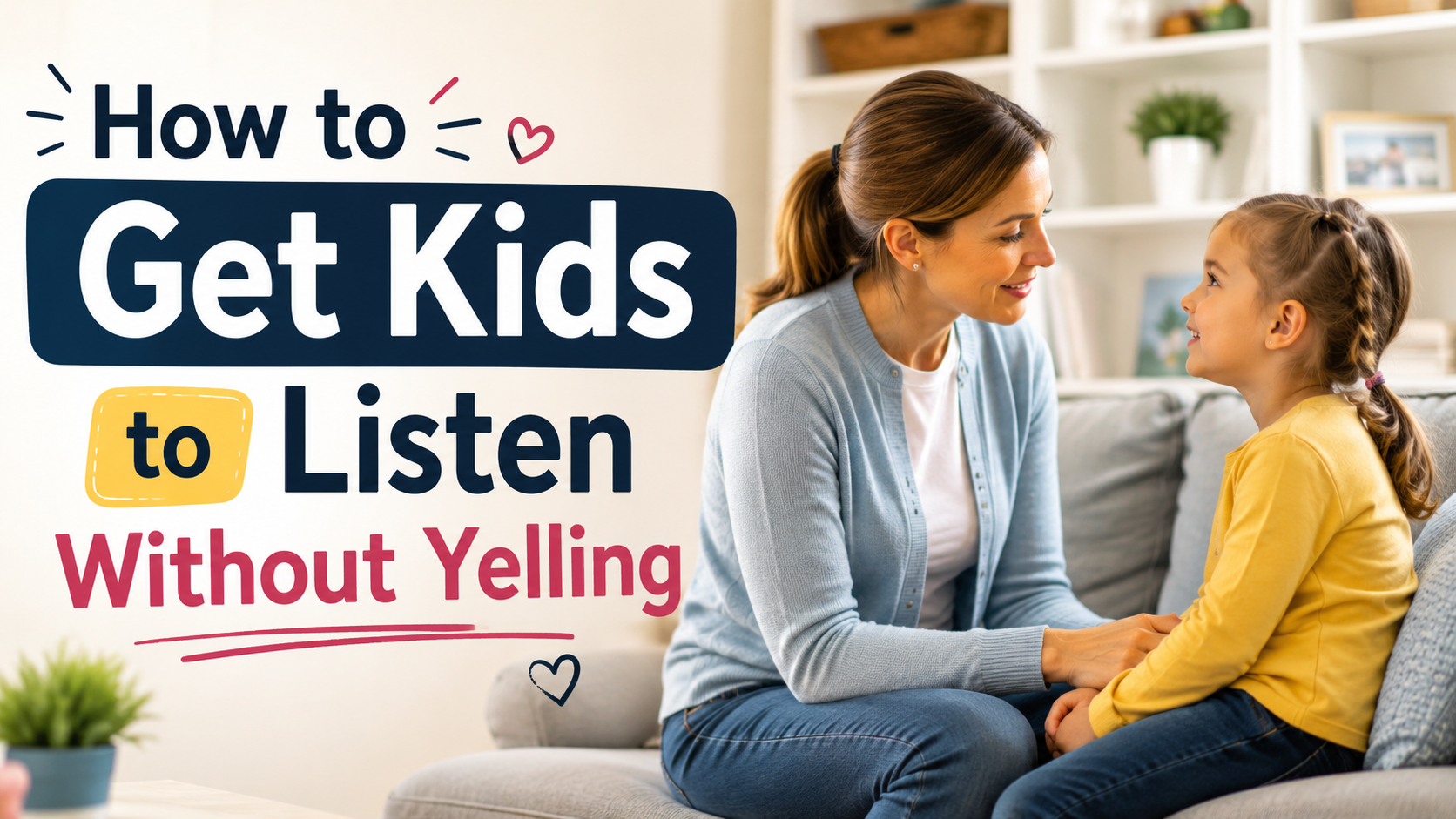
To get kids to listen without yelling, connect first, give one calm, clear instruction, and follow through every time. Children respond better to consistent limits, simple language, and specific praise than to repeated shouting or long lectures.
If you want how to get kids to listen without yelling to actually work in real life, think less about volume and more about rhythm. The goal is not to control your child with fear. The goal is to build a pattern where they know you mean what you say, feel safe with your tone, and understand exactly what to do next.
How to Get Kids to Listen Without Yelling: The Core Method
The simplest formula is this: pause, connect, instruct, follow through, notice cooperation. That is the backbone of parenting without yelling, positive discipline methods, and strong parenting communication skills.
Start by getting close. Move to your child, get at eye level, and say their name before giving a direction. This boosts attention and helps your child feel engaged rather than barked at. Active listening and calm body language also make children feel safer and more connected.
Then give one short instruction. Not three. Not a speech. Use phrases like “Put on your shoes” or “Place the blocks in the bin.” Simple, direct instructions are easier for children to understand, particularly when they are feeling upset or overwhelmed.
Finally, follow through calmly. If your child does not cooperate, use a predictable consequence or a logical next step instead of raising your voice. Consistency teaches faster than intensity.
Key Takeaways
|
Situation |
Better response |
Why it works |
|
Child ignores you |
Move close, make eye contact, give one direction |
Attention improves when instructions are direct and personal |
|
Child argues |
Stay calm and repeat the limit once |
Calm consistency reduces escalation |
|
Child resists transitions |
Use routines, warnings, and limited choices |
Predictability increases cooperation |
| Child misbehaves for attention |
Catch good behavior fast |
Specific praise reinforces what you want repeated |
|
Parent feels triggered |
Pause, breathe, reset before speaking |
Self-regulation helps kids regulate too |
Why Yelling Backfires
Yelling may get a child’s attention for a second, but it rarely builds lasting listening skills. Kids either escalate, shut down, or start tuning the yelling out because it becomes familiar background noise.
That is why many parents feel trapped. They yell, the child pauses, then the problem returns. Over time, this can create a cycle where both parent and child get louder and more reactive.
Research indicates that harsh verbal discipline, including yelling, can contribute to a rise in behavioral problems and depressive symptoms among adolescents over time. Although a positive parent-child bond can be beneficial, it cannot fully undo the harmful impact of continued harsh verbal discipline.
In short, if you want to stop yelling at kids and still improve child behavior, loud is not the answer. Calm authority is usually stronger than emotional intensity.
Positive Parenting Techniques That Actually Work
The best positive parenting techniques do not remove limits. They make limits clearer, calmer, and easier to follow.
1. Set clear rules before the problem starts
Children listen better when expectations are predictable. Instead of correcting constantly, decide on a few family rules and repeat them often in simple language. The CDC recommends being clear and consistent, and showing children what you expect them to do.
2. Use noticing statements and labeled praise
Instead of a vague “good job,” say, “I noticed you put your cup in the sink the first time I asked.” This kind of praise tells children exactly which behavior to repeat. UNICEF specifically recommends noticing statements, and the AAP emphasizes catching children being good.
3. Give limited choices
Choice reduces resistance. You might say, “Do you want the red pajamas or the blue pair?”
The child continues to follow the plan while also having a slight feeling of control.
The CDC recommends a limited number of simple choices to help cooperation.
4. Use natural and logical consequences
A consequence is most effective when it is directly related to the behavior.
If toys are thrown, the toys get put away. If a child delays leaving, playtime ends sooner. Consequences should be calm, immediate, and consistent.
5. Redirect instead of lecturing
Many young children misbehave because they are bored, overstimulated, or unsure what to do. Redirection works better than long explanations. Give them a different action, object, or job.
These are the kinds of gentle parenting discipline tools that still hold boundaries. Gentle does not mean passive. It means regulated, respectful, and firm.
How to Talk So Kids Will Listen
If you want effective communication with kids, cut the extra words. Most children stop processing once a parent turns a direction into a mini TED Talk.
Use age-appropriate words. Speak clearly. Say what you want them to do, not only what to stop doing. The CDC recommends following “no” with what the child should do instead, and UNICEF recommends clear, specific language that feels respectful.
Here is a simple script that helps build better parent-child communication:
- “Look at me, please.”
- “Here’s what needs to happen.”
- “First shoes, then outside.”
- “You’re upset. I get it.”
- “The limit stays the same.”
That approach is effective because it combines emotional support with clear guidance.
Children are more likely to cooperate when they feel heard, even if they do not get their way. Active listening and reflective listening help them feel understood without removing the boundary.
This is the heart of how to talk so kids will listen. You validate feelings. You do not negotiate every limit.
Calm Parenting Strategies for Hard Moments
The hard truth is this: most yelling starts before the words come out. It starts when the parent is overloaded.
If you want real calm parenting strategies, learn your triggers. Common ones include rushed mornings, hunger, bedtime, sibling conflict, too much multitasking, and unrealistic expectations. Child Mind Institute recommends identifying recurring problem interactions and planning for them.
Try this quick reset:
- Stop talking for five seconds.
- Exhale slowly.
- Move closer instead of louder.
- Give one instruction.
- Follow through without debate.
That pause matters. When parents regulate themselves, they model self-regulation for children too.
If you do yell, repair quickly. You can say, “I’m sorry I yelled. I’m going to say that again calmly.” Repair does not weaken authority. It strengthens trust and models accountability. Child Mind Institute recommends owning your feelings and repairing after a blowup.
Age-by-Age Tips to Improve Child Behavior
Children do not all listen the same way. Development matters.
Toddlers: keep it one step and concrete
Toddlers need short directions, physical proximity, and fast redirection. “Hands on the cart” works better than “How many times do I have to tell you not to keep wandering off?” Clear limits and modeling matter more than long explanations.
Preschoolers: use routines and choices
Preschoolers do well with structure, simple chores, and limited choices. The CDC recommends helping them solve problems, using complete sentences, and being clear and consistent when disciplining.
School-age kids: explain, then expect follow-through
Older children can handle more reasoning, but they still need concise instructions. This is a great age to teach responsibility with logical consequences and specific praise for effort, cooperation, and self-control.
Tweens and teens: respect matters more than ever
Older kids are especially sensitive to tone and perceived disrespect. Harsh verbal discipline can feed conflict and emotional distress, while calm firmness preserves connection better.
Common Mistakes That Make Kids Stop Listening
Many parents are not too soft. They are just stuck in patterns that accidentally train kids to wait them out.
One common mistake is repeating yourself five times. That teaches children that the first instruction is optional. Another is yelling from another room. If you want cooperation, go to the child, say the instruction once, and make sure they are actually attending. This lines up with UNICEF’s emphasis on active, respectful communication and the CDC’s recommendation for clear expectations. Another mistake is using threats you will not enforce. Empty threats weaken your words fast. Calm follow-through is what helps teach kids to follow instructions and encourages children to listen over time.
What to Do Instead of Yelling
If you are trying to discipline without shouting or figure out how to make children listen, keep a few go-to phrases ready.
For cooperation
- “First homework, then screens.”
- “When your shoes are on, we leave.”
- “You may be mad. You may not hit.”
- “I’ll help you start.”
For boundaries
- “I won’t let you throw that.”
- “The rule is still the rule.”
- “You can do it now, or I can help you do it.”
For repair
- “I’m sorry I raised my voice.”
- “Let me try that again calmly.”
- “We’re both having a hard moment.”
These phrases work because they are brief, respectful, and firm. They support respectful parenting tips, peaceful parenting tips, and better parenting communication skills without sounding robotic.
Quick Summary: How to Get Your Child to Cooperate
If you want to get kids to listen, focus on these five moves:
- Connect before correcting
- Use one clear instruction
- Stay calm and close
- Follow through every time
- Praise the behavior you want more often
That is how you reduce power struggles with kids and make listening more likely without turning every moment into a battle.
Final Takeaway
The best answer to how to get kids to listen without yelling is not a magic phrase. It is a repeatable pattern. Calm connection, clear instructions, and consistent follow-through teach children what yelling never can: how to cooperate, regulate, and trust your leadership.
If you want to stop yelling at kids, start by using fewer words, not more boundaries. Be warm. Be clear. Mean what you say. That combination is powerful.
FAQ
Why does my child only listen when I yell?
Usually, they are reacting to intensity, not learning the skill of listening. If yelling has become the signal that “this time mom or dad is serious,” your child may have learned to wait for escalation. Calm, immediate follow-through helps break that pattern.
How do I discipline without shouting?
Use clear rules, one-step directions, logical consequences, and specific praise. Discipline works best when it is calm, predictable, and tied directly to the behavior.
What if my child ignores me the first time?
Do not repeat yourself from across the room. Move closer, get attention first, restate the instruction briefly, then follow through. Children often respond better when directions are direct, specific, and personal.
How can I stop yelling at my kids so much?
Watch for your own triggers. Rushed transitions, hunger, multitasking, and fatigue make yelling more likely. Planning, pausing before speaking, and repairing after slip-ups can help you shift the pattern.
Does gentle parenting mean no consequences?
No. Gentle parenting discipline still includes consequences. The difference is that the consequences are calm, respectful, and connected to the behavior, rather than driven by anger.
How do I reduce power struggles with kids?
Offer limited choices, keep instructions short, validate feelings, and avoid turning every limit into a debate. Predictable routines and calm follow-through reduce the need for daily battles.
For more information Click here.